



Quick Answer: Is There a Winning Race Track Strategy?
No betting pattern changes your long-run odds in Race Track. Every runner on the board returns 96% of the money staked over time, so the casino keeps 4% whichever lane you back, however many runners you cover and however long you wait for a "streak" to end. What a strategy can change is how bumpy your session is and how much money you put through the game. That is all this guide promises, and it is the reason the numbers below are worth more than a system that claims otherwise.
Race Track at a glance
Here is what you get:
- how a round works and how to read the six prices on the board
- the real win chance behind every price, which you can work out yourself in ten seconds
- four common approaches compared with real percentages, including the "cover" approach we played ourselves
- a worked payout example from a real round
- the tips that matter: chip size, stop-loss and skipping rounds
New to live casino games? Our crypto casino games guide covers the main categories, and the Crazy Time strategy guide does the same kind of maths for Evolution’s wheel game.
Where to Play Race Track
These casinos from our reviews carry Race Track in the live casino lobby. Availability can depend on your country, so search the lobby for "Race Track" after you sign up.















How Race Track Works
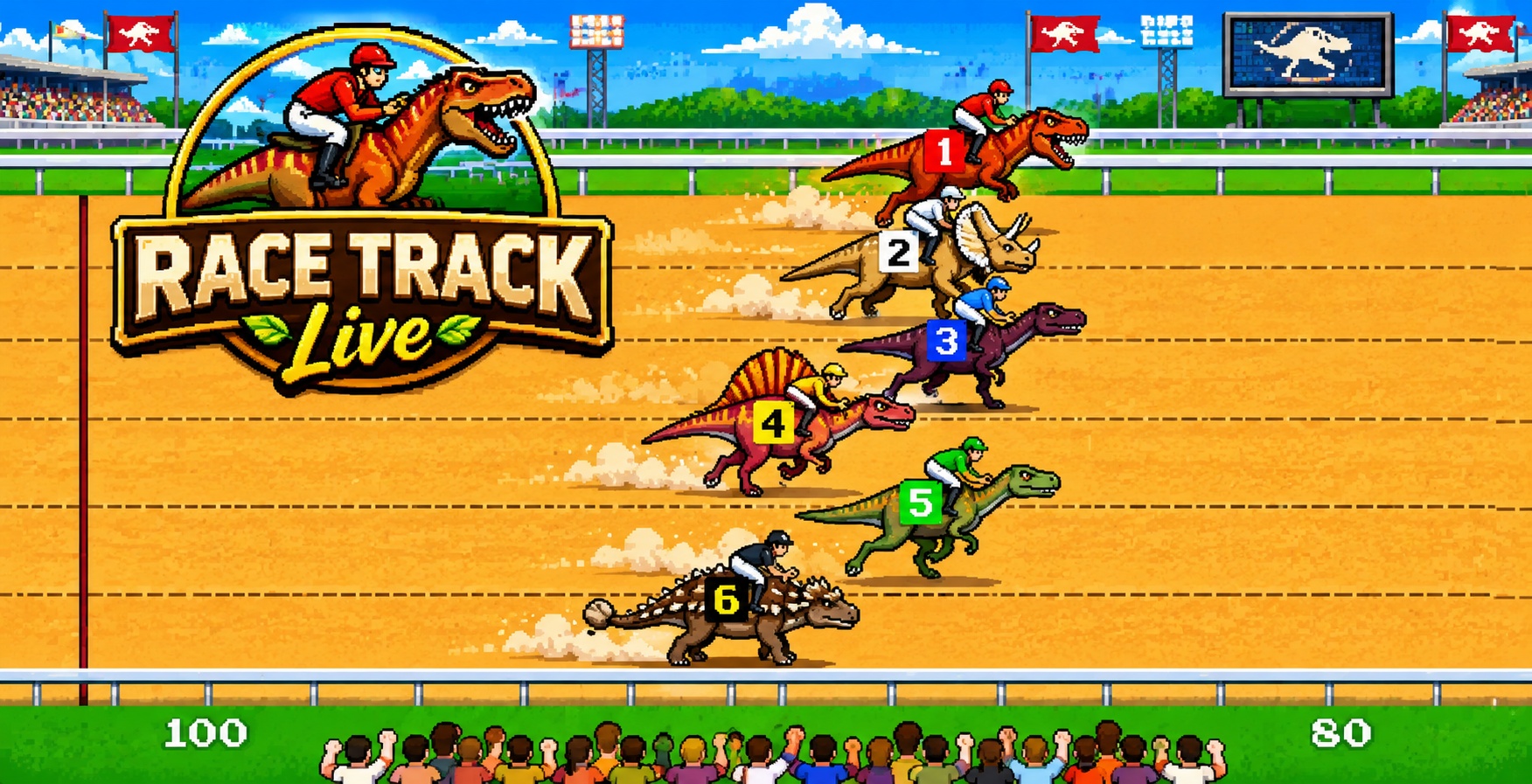
Race Track is a live game show from Evolution. A short pixel-art race plays out on screen while a presenter appears in a small video window. In the mobile version we played, the runners are dinosaurs with jockeys. Review sites describe horse-themed versions too, and the maths is the same.
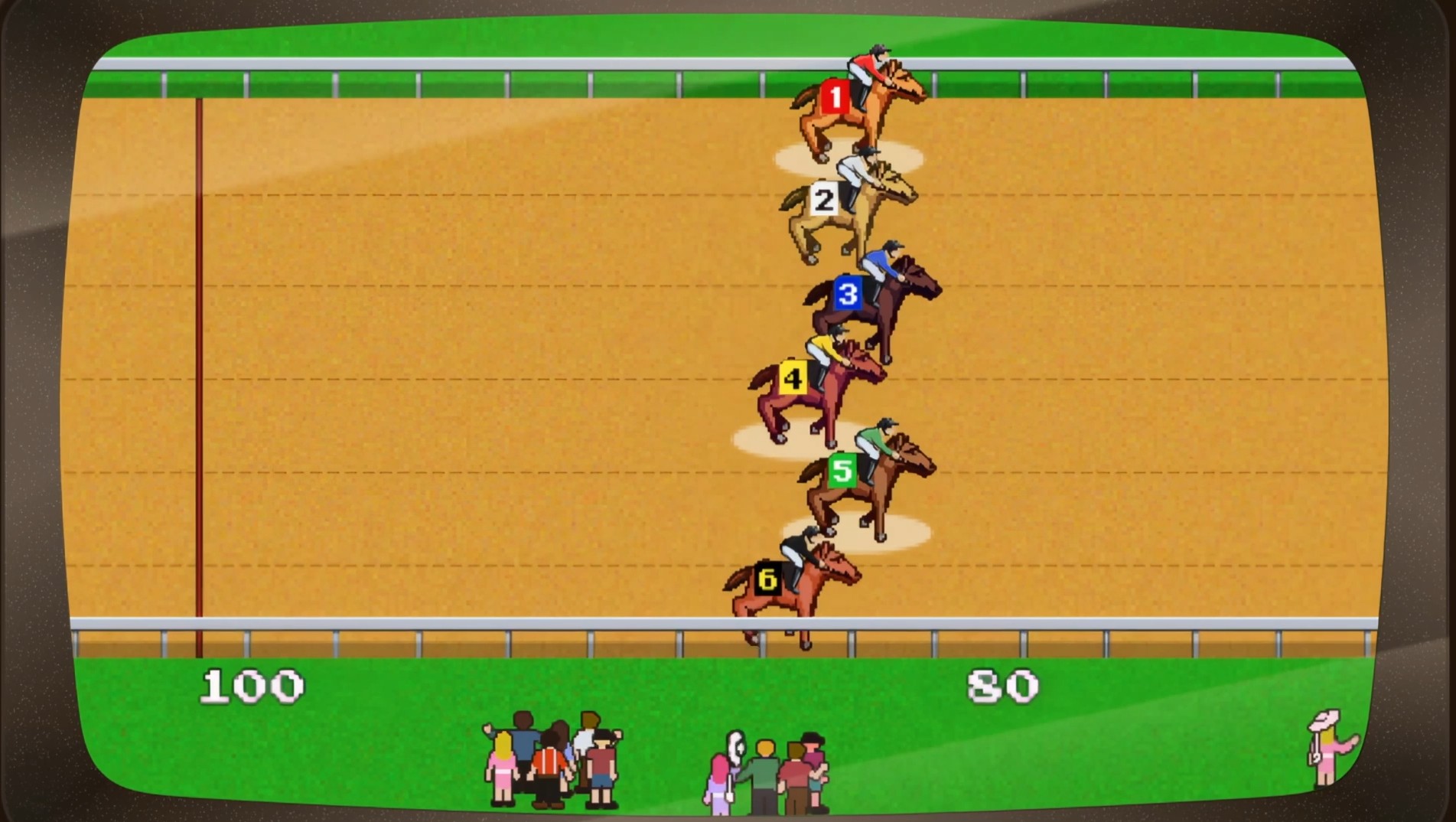
Each race has six runners, numbered by lane and colour: 1 red, 2 white, 3 blue, 4 yellow, 5 green and 6 black. According to casino review sites they are drawn from a pool of 50 and change from race to race, so a name on its own tells you nothing. Gonzo, for example, was in lane 3 on one board we recorded and in lane 4 on another. Lanes are ordered by price: lane 1 is the shortest price (the favourite) and lane 6 the longest (the outsider). Review sites also say each race has two strong runners, two average and two outsiders, which fits the price steps we saw on the boards.
How a Race Track Round Works
Place Your Bets
Watch the Race
Get Paid
On the board we used there is one kind of bet, a win bet on a runner, and you can back several runners in the same round. That is what makes the "cover" approach below possible.
Race Track Limits and What We Could Not Verify
Our table showed a betting range of €0.10 to €5,000. Some sources quote a higher ceiling and a maximum win cap, and limits depend on the casino and the table, so read the figure in your own lobby instead of trusting any guide, this one included. We could not find a public rules page from Evolution for Race Track, so the size of the runner pool, the strong/average/outsider split and the betting window come from casino review sites. The 96% RTP we checked ourselves from the prices on the board, as shown next.
Race Track Odds and Win Probabilities
A price like 3:1 means you win €3 profit for every €1 staked, and you also get your stake back. The price tells you what the casino pays. To see what it implies about your chances, convert each price to a share with 1 ÷ (price + 1).
Here is a real board from one of our rounds:
| Lane | Runner | Price | Implied by price | Real win chance | Total return on €10 |
|---|---|---|---|---|---|
| 1 | Lover | 2:1 | 33.3% | 32.0% | €30 |
| 2 | The Beeb | 3:1 | 25.0% | 24.0% | €40 |
| 3 | Lion | 4:1 | 20.0% | 19.2% | €50 |
| 4 | Gonzo | 7:1 | 12.5% | 12.0% | €80 |
| 5 | Big Red | 11:1 | 8.3% | 8.0% | €120 |
| 6 | Odd Shoe | 19:1 | 5.0% | 4.8% | €200 |
| Total | 104.2% | 100% |
The implied shares add up to 104.17%, not 100%. The extra 4.17% is the casino’s margin. Divide 100 by 104.17 and you get 0.96, which is the 96% RTP. The real win chance of each runner is its implied share divided by 1.0417. The second board we saved (1:1, 3:1, 7:1, 9:1, 17:1 and 89:1) also adds up to 104.17%, so the same rule holds when the prices change.
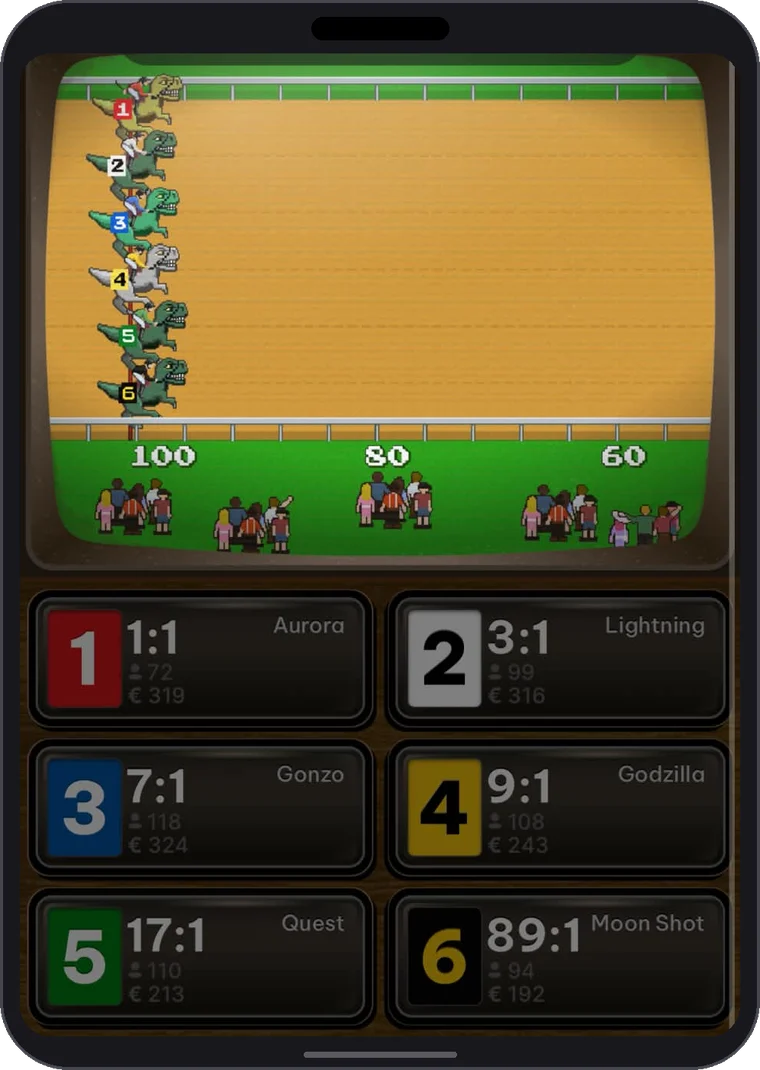
Two things follow from this. First, every runner has the same expected return: €10 on the 32% favourite and €10 on the 4.8% outsider both lose €0.40 on average. Second, the favourite is not "safer" in money terms. It simply loses less often and pays less when it wins.
This assumes the random draw follows the displayed prices, which is what the 96% figure from review sites implies. We plan to check that against logged rounds rather than ask you to take it on trust.
Race Track Strategies Compared
We took the board above and calculated what common approaches do. The first table shows a single round with a base chip of €1 on each runner you back.
| Approach | Total staked | Chance the round is a profit | Best result | Worst result | Average result |
|---|---|---|---|---|---|
| Favourite only (lane 1) | €1 | 32.0% | +€2 | −€1 | −€0.04 |
| Two favourites (lanes 1 and 2) | €2 | 56.0% | +€2 | −€2 | −€0.08 |
| Cover: lanes 2 to 6, skip the favourite | €5 | 24.8% (19.2% break-even) | +€15 | −€5 | −€0.20 |
| Outsider only (lane 6) | €1 | 4.8% | +€19 | −€1 | −€0.04 |
Look at the last column. Divide it by the amount staked and every approach lands on −4%. The approaches differ only in how often they win and how large the wins and losses are.
Over many rounds the picture spreads out. We simulated at least 20,000 sessions per approach using the prices above, betting every round with the same chip. Results are in multiples of your base chip.
| Approach | Ahead after 25 rounds | Typical result after 25 | Ahead after 100 rounds | Typical result after 100 | Range covering 90% of 100-round sessions |
|---|---|---|---|---|---|
| Favourite only | 41% | −1 | 37% | −4 | −28 to +20 |
| Two favourites | 39% | −2 | 31% | −8 | −36 to +20 |
| Cover, lanes 2 to 6 | 39% | −6 | 33% | −21 | −99 to +63 |
| Outsider only | 34% | −5 | 35% | 0 | −60 to +60 |
With a €5 chip, the cover approach over 100 rounds ends anywhere from about −€495 to +€315 in nine sessions out of ten. A result like €100 turning into €400 is possible, and so is the opposite. Which one you get is luck, and the loss side is just as long as the win side.
So pick an approach for how it feels, not for an edge it does not have. Frequent small wins suit favourites. Rare big hits suit the cover or outsider style, and they need a bigger bankroll to survive the dry spells.
The Cover Approach: Worked Example
The cover approach backs five of the six runners and leaves out the favourite. We used it in our test sessions, and it is a popular style among players who want a win to repay several losing rounds at once. Here is how it plays out on the board from the table above, with €5 on each of lanes 2 to 6 (€25 in total).
| Winning runner | Chance | Total return | Result for the round |
|---|---|---|---|
| Lane 1, Lover (2:1) | 32.0% | €0 | −€25 |
| Lane 2, The Beeb (3:1) | 24.0% | €20 | −€5 |
| Lane 3, Lion (4:1) | 19.2% | €25 | €0 |
| Lane 4, Gonzo (7:1) | 12.0% | €40 | +€15 |
| Lane 5, Big Red (11:1) | 8.0% | €60 | +€35 |
| Lane 6, Odd Shoe (19:1) | 4.8% | €100 | +€75 |
In our screenshot round, Odd Shoe in lane 6 won. The game paid €100 on a €5 bet, so the round netted +€75 after the other four stakes. That one hit repays three complete losses of €25.
It is easy to see why this feels safe after a few losing rounds, but the arithmetic has a catch. You lose money in 56% of rounds, break even in 19.2% and profit in 24.8%. The chance of lane 6 winning is still 4.8% on every single round, whether you have just lost one or five. Average result per round: −€1 on €25 staked, or −4%.
The rules we followed
- Keep the total stake small. We kept the stake for all five runners combined to a small slice of the bankroll (roughly 5 to 7% in our screenshot round). A flat stake means you never raise it to chase a loss.
- Skip rounds where the favourite is 1:1. A 1:1 favourite wins about 48% of the time, so the cover loses its whole stake almost every second round (against 32% on the board above). Skipping does not improve the average return, because every round is −4%, but it cuts down the heavy losses and the total you wager.
- Set a stop-loss before you start and leave when you hit it.
Our Race Track Test Sessions
We have played Race Track ourselves, mostly on mobile. These are the two sessions so far, using the cover approach described above.
| Session | Length | Starting balance | Result |
|---|---|---|---|
| 1 | About 2 hours | €100 | Finished close to €400 |
| 2 | 30 to 40 minutes | €100 | Finished €85 ahead |
Two sessions are a tiny sample, and both finishing ahead is an ordinary outcome that happens in roughly a third of sessions for this style (see the 100-round table above). They tell you what the approach can do, not what it will do next time. We plan to record a longer session and publish the round-by-round results, including how often each lane actually won against its price, so you can see the data for yourself.
Race Track Myths: Streaks, Pots and Hot Runners
"Wait until the favourite wins a few times in a row"
Many players wait for two to four favourite wins and then back the outsiders, on the idea that the pattern has to break. It does not have to. Each race is drawn independently, so the favourite’s chance on the next round is the same whether it won the last four or lost them. Waiting changes how many rounds you play, not the odds of any round.
"Watch the money on each runner"
The board shows how many players back each runner and how much they have staked. On the board we saved, €319 was on the 1:1 runner and €192 on the 89:1 runner, so the crowd bets fairly evenly instead of following the prices. Your payout is fixed by the price on the board, not by the pot, so those figures are other players’ stakes and not a tip. We have seen a big pot on the favourite win once and lose once. Two rounds prove nothing, and we will log the pots alongside the results to check whether they carry any signal.
"Use the statistics screen"
Evolution’s game shows recent results (review sites say the last 100 races). It is fun to look at, but past winners tell you nothing about the next race, for the same reason as above.
"A system can beat a 4% edge"
It cannot. Staking plans, covers and waiting rules all rearrange the same expected loss of 4% of what you wager. Any guide that promises otherwise is selling a feeling, not a result.
Race Track Tips That Actually Matter
- Your expected loss is 4% of everything you wager. That is €40 per €1,000 staked. The only thing you control is how much you stake in total, so fewer and smaller bets cost less.
- Skipping a round is free. You never have to bet. Sit out boards you dislike.
- Size your chip for a bad run. Pick a total stake per round that lets you lose 20 rounds in a row without ending the session. A common rule of thumb is 2 to 5% of the bankroll for all runners combined.
- Decide the stop-loss and the win goal in advance. Write down both numbers before the first bet and leave when you reach either.
- Never raise the stake after a loss. Chasing is how a controlled session becomes an expensive one.
- Read the table limits. Limits vary by casino and table. Check the range shown at the bottom of the game before you plan chip sizes.
- Check the bonus terms. Live games often count little or nothing towards bonus wagering. Read the rules before you play Race Track with bonus money.
- Watch a few rounds first. You can open the table and read the board without betting.
- Set a time limit. Rounds follow each other quickly, so it is easy to lose track of how much you have staked.
Race Track vs Crazy Time
Race Track and Crazy Time are both Evolution live games, but they ask different things of you. This is how they compare on the points that matter for strategy.
| Feature | Race Track | Crazy Time |
|---|---|---|
| What you bet on | One or more of 6 runners | Bet spots on a 54-segment wheel |
| Return to player | 96% on every runner | About 95.3% to 96.1%, depending on the bet |
| Bonus rounds | None on the board we played | Four bonus games with large multipliers |
| Where the swings come from | Which runners you back and how many | Mostly from the bonus rounds |
| Best suited to | Players who want to set their own risk level each round | Players who want show-style bonus rounds |
Because every runner returns the same 96%, Race Track is simpler to analyse: no bet is better than another, only different shapes of risk. Our Crazy Time strategy guide covers the wheel in the same way, and the casino games guide shows where both sit among the other live games.
Ready to Try Race Track?
If you want to try the approaches above, start with a small stake and the limits set before the first bet. Both casinos below have Race Track in the live lobby.

200% up to €3,000 + 50 Free Spins
- Near-instant crypto withdrawals
- 15+ cryptocurrencies
- 8,000+ games

20% up to €250 on your first deposit
- Race Track in the live lobby
- Crypto payments supported
Play Race Track Responsibly
Race Track is entertainment with a built-in 4% cost, not a way to make money. Only play with money you can afford to lose, set deposit and time limits before you start and never chase losses. You must be 18 or older, or the legal age where you live. If gambling stops being fun, free confidential help is available at BeGambleAware and GamCare.
Frequently Asked Questions (FAQs)
No. The game has a 96% RTP, so the casino keeps 4% of all money staked, and every runner has the same expected return. Strategies change how often you win and how large the swings are, but not the average result.
96%, which means a house edge of 4%. You can check it on any board: the prices converted to shares add up to 104.17%, and 100 divided by 104.17 is 0.96.
A price such as 7:1 pays €7 profit per €1 staked, plus your stake back. The real win chance is 1 divided by (price + 1), divided again by 1.0417 to remove the casino margin. For 7:1 that is 12%.
Any of them has the same average return. The favourite in lane 1 wins most often and pays least, and the outsider in lane 6 wins rarely and pays most. Choose by how much variance you are comfortable with.
No. Every race is drawn independently, so previous results do not change the chances of the next race. Waiting only reduces the number of rounds you play.
The table we used showed a betting range of €0.10 to €5,000, and we saw prices up to 89:1. Some sources quote different ceilings and a maximum win cap, so check the limits in your own casino lobby.
Six. Review sites say they are drawn from a pool of 50, with two strong runners, two average runners and two outsiders in each race.
Among our reviewed casinos: 30-Casino, XsBets, Whale.io, SpinBetter, Cosmobet, Rolletto, Velobet, Dolfwin, SpinPlatinum and DailySpins. Availability can vary by country.
Live Evolution tables are normally real-money only, but you can open the table and watch rounds without placing a bet to learn the board.
Review sites describe a statistics view with the results of the last 100 races and suggested runners. It is only a record of past races. Because each race is independent, it does not predict the next one.
Neither has a better return. Race Track pays 96% on every runner, while Crazy Time pays between about 95.3% and 96.1% depending on the bet. Race Track suits players who want to choose their own risk level, and Crazy Time suits those who want bonus rounds.